火影忍者
“올해도 예매 전쟁”…경복궁 야간관람, 주말·추석 연휴 매진_我的网站

一 |
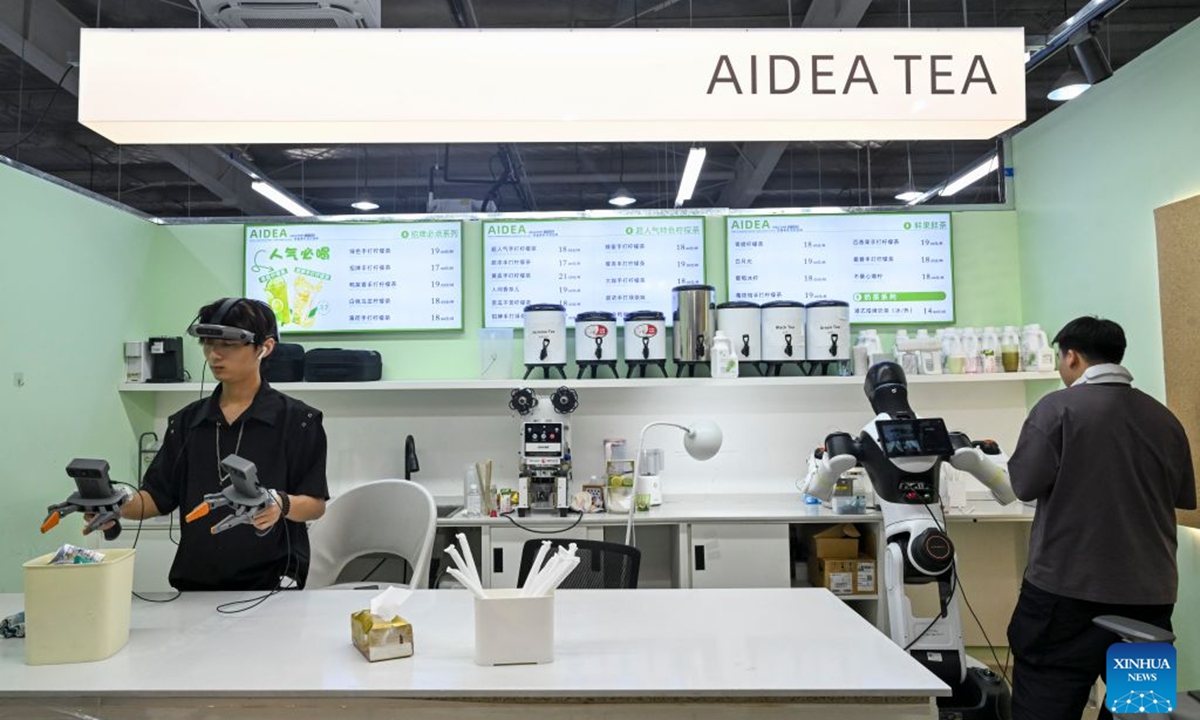
Staff members train a robot to work in a retail scenario at Maniformer, a physical AI data service platform, in Shanghai, east China, Aug. 5, 2026. In Shanghai's tech companies like AGIBOT and Maniformer, embodied intelligence robots are trained in household, retail, sorting, production and other real-world scenarios, to advance their AI capabilities for real-life use. (Xinhua/Chen Haoming)
Nation's value added in the service sector grew 5.2 percent year-on-year, 0.5 percentage points faster than overall economic growth. Retail sales of services rose 5.3 percent year-on-year. In the first half of the year, the service sector expanded steadily, playing an important role in supporting industrial upgrading and meeting people's livelihood needs.
A meeting of the Political Bureau of the Communist Party of China (CPC) Central Committee held on July 30 called for effectively expanding domestic demand and optimizing supply.
From April 7 to 8, a national conference on the service sector was held in Beijing — the first national gathering in the new era devoted to the service sector.
General Secretary Xi Jinping called for advancing producer services toward greater specialization and the higher end of the value chain, fostering high-quality, diverse and accessible consumer services, and building more "China Services" brands, as well as striving to break new ground in the high-quality development of China's service sector.
Beijing convened a municipal service sector conference and pledged to actively shape the "Beijing Services" brand.
Shanghai released its 15th Five-Year Plan (2026-30) for service sector development, aiming to comprehensively enhance the global reach and international competitiveness of "Shanghai Services."
Southwest China's Chongqing Municipality set out to build a modern service industry system and burnish "golden calling cards" of service development such as "Chongqing Trade Global."
Since the national conference, regions and departments have coordinated their planning and accelerated the building of service brands. By 2030, China's service sector is expected to top 100 trillion yuan ($14.6 trillion) in total scale, with higher quality, a better structure and improved standards.
With that target in sight, the Chinese economy is undergoing a fresh "system upgrade."
IBuilding more "China Services" brands is an inevitable choice that follows the laws of economic development and drives economic transformation and upgrading.
China's service sector has steadily expanded in scale and continuously improved in quality and efficiency since the 18th National Congress of the CPC, playing an important role in supporting industrial upgrading, meeting people's livelihood needs and driving job growth, according to Xi.
Scale is the most direct yardstick. In the first half of this year, the service sector accounted for 59.5 percent of GDP, making it the largest sector of the national economy, and contributed 66.1 percent to economic growth, emerging as the main engine of expansion. The figures reflect the sector's weight in high-quality development and in Chinese modernization as a whole.
The Chinese economy sits at a critical window as it shifts from factor-driven to innovation-driven growth, and from investment-led to consumption-led expansion. Projections show that during the 15th Five-Year Plan period, the service sector's contribution to GDP growth will rise steadily, making it the economy's main engine in every sense.
This is also where the key lies in answering people's expectations for a better life and in expanding domestic demand.
The changing Engel coefficient traces the leap in household consumption. At the start of reform and opening-up, the Engel coefficient for Chinese households exceeded 60 percent; in 2025 it stood at just 29.3 percent. The sharp drop in the share of spending on food has freed up vast room for consumption of services such as education, health, culture and tourism.
Global experience shows that once a country's per capita GDP passes $10,000, its consumption structure typically shifts markedly, with services taking a rapidly rising share. China is now in that critical transition. Consumption is moving from "subsistence consumption," geared mainly to basic needs, toward "development-oriented consumption" that seeks quality, experience and self-fulfilment.
From the breakout popularity of the Jiangsu Football City League and the Village Super League to the growing craze for "traveling to catch a show"; from the rapid spread of service points for the elderly and young children to 30-minute delivery of just about anything becoming the norm — service consumption is no longer an optional garnish but a necessity of a better life. With a middle-income group of more than 400 million, China is entering a golden period for expanding the capacity and quality of its service sector.
It is also a key step toward raising total factor productivity and developing new quality productive forces.
Take a garment company. In R&D, AI-assisted design can shorten development cycles. In production, intelligent transformation and digital upgrading can sharply lift efficiency. In distribution, modern logistics can cut overall costs. In sales, market analytics can match products precisely to customer segments.
Globally, as industries divide labor more deeply and integrate faster, leading manufacturers are broadly shifting toward service-oriented manufacturing, drawing on strengths in information, finance, R&D and design to dominate the construction of global value chains. Producer services play an increasingly prominent role in production networks, and largely determine whether product value can extend toward both ends of the "smile curve."
As the world's largest manufacturing nation, China still sees producer services account for less than 35 percent of GDP in value added, leaving gaps in scale, quality and efficiency compared with advanced international levels. Upgrading the service sector is key to moving from a manufacturer of quantity to one of quality.
IIIn building more "China Services" brands, tailoring measures to local conditions and applying targeted policies is the basic methodology.
Underscoring demand-driven development, reform breakthroughs, technology empowerment as well as opening-up and cooperation, Xi called for carrying out capacity-expanding and quality-upgrading initiatives in the service sector.
The service sector spans many categories and takes many forms; its subsectors differ in their levels of development and the challenges they face.
Start with producer services, these must serve enterprises across the full span of production and operations, with the aim of firmly supporting industrial transformation and upgrading by shoring up weak links along the entire chain.
Among these, the deep integration of advanced manufacturing and modern services — the so-called integration of the two sectors — is one of the core propositions of current industrial policy. For a long time, manufacturing and services have operated on parallel tracks, belonging to different policy systems, statistical classifications and regulatory frameworks.
Breaking down this divide requires embedding services into every pore of manufacturing, and the breakthrough lies in data and policy. On one hand, the industrial internet should serve as the link that connects data silos, drawing service firms to develop specialized, manufacturing-oriented services on a data foundation and forming an ecosystem of "data flow — embedded services — value creation." On the other, statistical and policy systems need reform: drawing on international experience, service units inside manufacturers should be able to keep separate accounts and enjoy service-sector policy benefits, giving the integration of the two sectors a clear policy foothold.
Turn to consumer services. At their core, these address people's needs across the full life cycle, with the aim of better meeting aspirations for a better life by raising the development level of key consumer service areas.
Take elderly care and childcare. Demand is moving up from basic provision toward inclusive and even mid- to high-end services, and it is broadening: expectations now span facilities, services, and material and emotional needs alike. Supply-side structural strains are equally acute. In some big cities, beds at high-quality elderly care institutions are nearly impossible to secure, while many beds sit empty at township homes for the elderly. Places at standardized chain childcare centers are hard to come by, even as some small childcare providers struggle to stay in business.
Faced with strains that are multilayered and varied, only precise disaggregation and tiered policies can deliver genuine quality upgrades.
At the baseline, the government should take the lead in improving the three-tier elderly care network across counties, townships and villages, reinforcing the social safety net. At the middle tier, the government should guide the way — using investment, tax and fee incentives, resource guarantees and institutional reform to mobilize more social forces, so that more families can access elderly care and childcare that is affordable, reliable in quality and safe. At the upper tier, industrial policy and a better business environment should support market players in providing personalized and customized services.
IIIBuilding more "China Services" brands means seizing the initiative through the newness of innovation and winning reputation through the substance of quality.
Building more "China Services" brands requires deepening institutional opening-up.
Brands are forged only in open competition. However, barriers in goods trade sit mainly "at the border" — tariffs and customs clearance — while barriers in services trade are more often hidden "behind the border," in market access rules, regulatory systems, qualification recognition and the mutual recognition of professional credentials.
China needs to keep refining the negative list for the service sector and further trim its scope, so that it becomes a genuinely predictable and workable opening-up commitment. It also needs to improve regulatory transparency and consistency, align regulatory rules with prevailing international practice, and reduce hidden barriers. At the same time, cross-border mutual recognition of professional credentials for engineers, physicians and others should be actively advanced, allowing high-end service talent to move freely.
Building more "China Services" brands also means that, as the saying goes, it takes a good blacksmith to forge good iron.
A recent piece of news drew global attention: Mixue Ice Cream & Tea has grown to nearly 60,000 stores worldwide, becoming a food and beverage chain of broad global influence.
Behind Mixue's success lies an intelligent supply chain system. At the front end, it converts consumption data into planting data, guiding farmers to produce to order. In the middle, an intelligent scheduling system coordinates nearly 30 warehouses nationwide, with cold chain coverage reaching more than 97 percent of stores. At the tail end, algorithms provide precise support for choosing store locations. Foreign media have remarked that the chain store's mascot "Snow King" will turn up in your city sooner or later.
Differentiated competition among service brands, in the end, comes down to a contest of innovation capability. For "China Services" brands to truly stand firm, make a name and travel far, they must seize the initiative through the newness of innovation, pushing continuous breakthroughs in service models, technologies and consumption scenarios, and win reputation through the substance of quality.
From selling products to selling services, from "Made in China" to "China Services" — as a 100-trillion-yuan service landscape slowly unfolds, there is reason to believe that these gleaming "China Services" calling cards will converge into powerful momentum for the high-quality development of the Chinese economy.
This was compiled from an article originally published on the front page of the People's Daily on August 13, 2026. 。
26일 예매 시작과 동시 주말 관람권 동나추석 연휴도 ‘잔여 0’…하루 3000매 판매9월 2일부터 한 달간 운영[이데일리 이윤정 기자] 매년 높은 인기를 끄는 ‘경복궁 야간관람’이 올해도 매진 행렬을 이어갔다. 예매 첫날부터 주말과 추석 연휴 관람권이 동났다.26일 NOL 티켓에 따르면 이날 오후 기준 ‘2026년 하반기 경복궁 야간관람’의 9월 주말 관람권은 대부분 매진됐다. 9월 4~6일과 11~13일, 18~20일을 비롯해 추석 연휴가 포함된 23~27일, 10월 2일 관람권의 잔여 수량은 ‘0’이다.NOL 티켓 관계자는 “일자별로 3000매씩 판매했고, 평일에는 아직 잔여석이 있지만 주말과 추석 연휴는 거의 매진됐다”며 “2차나 추가 판매 물량이 없어 현재 잔여 수량이 0으로 표시된 날짜는 예매가 마감된 상태”라고 말했다.
| | | 경복궁 야간관람이 시작된 후 경복궁 근정전에 조명이 켜져 있는 모습(사진=연합뉴스). |
|
경복궁 야간관람은 야간에 도심 속 고궁을 둘러볼 수 있는 대표적인 궁궐 활용 행사다. 사전 예매가 치열하기로 유명해 매년 관람권을 구하기 위한 ‘예매 전쟁’이 벌어진다.야간에는 광화문을 비롯해 흥례문과 근정전, 경회루, 사정전, 강녕전, 교태전, 아미산 권역 등을 둘러볼 수 있다.경복궁 야간관람이 인기를 끄는 데는 낮과는 또 다른 고궁의 풍경도 한몫한다. 해가 지고 조명이 켜지면 근정전과 경회루 등 주요 전각이 밤하늘과 어우러져 색다른 정취를 자아낸다. 특히 연못에 불빛이 비치는 경회루 등은 사진을 남기려는 관람객들이 몰리는 대표적인 ‘인생샷’ 명소로 꼽힌다. 한복을 차려입고 고궁의 야경을 배경으로 사진을 찍는 모습도 쉽게 볼 수 있다.가을밤 고궁에서 궁중음악과 궁중무용을 감상할 수 있는 특별 공연도 마련했다. 공연은 9월 2~5일, 9~12일, 16~19일, 30일부터 10월 2일까지 총 15차례 수정전에서 열린다. 국립국악원 연주자들이 참여해 전통 궁중음악과 무용을 선보인다.올해 하반기 경복궁 야간관람은 9월 2일부터 10월 2일까지 한 달간 이어진다. 관람 시간은 오후 7시부터 9시 30분까지로, 입장은 오후 8시 30분에 마감한다. 매주 월요일과 화요일에는 운영하지 않는다. 주말과 추석 연휴 관람권은 대부분 매진됐지만, 일부 평일에는 아직 잔여석이 있어 NOL 티켓을 통해 예매할 수 있다.한복 착용자와 만 6세 이하 영유아, 만 65세 이상 어르신 등 무료관람 대상자는 별도의 입장권 예매 없이 입장할 수 있다. 외국인은 관람 당일 여권 등 신분증을 지참하면 광화문 매표소에서 현장 구매가 가능하다. 외국인 현장 판매분은 하루 300매로, 1인당 2매까지 구매할 수 있다.。
Current article:http://vdqbzj.zongchaeiwengshuabaisisuofu.sbs/list_hwavy/x4n.html
Published on:07:07:58